
Custom E-commerce Benefits: +25% Revenue & +30% Loyalty 2026

Personalized e-commerce solutions increase SMEs' revenue by 25% on average, yet many leaders still hesitate. This growth comes with an improved customer retention rate of 30% thanks to a consistent user experience. This guide details the concrete benefits, anticipated challenges, and selection criteria tailored for French SMEs aiming to accelerate their digital transformation.
Key Takeaways
| Point | Details |
|---|---|
| Revenue Growth | A custom solution generates on average 25% additional annual revenue |
| Strengthened Loyalty | Personalization improves customer retention by 30% |
| Process Automation | 40% reduction in order processing time thanks to integrations |
| Accessible Investment | Projects starting from €5,000 with visible ROI within 12 months |
| Support and Follow-up | Technical integration and ongoing training are essential for success |
Introduction to Custom E-commerce for SMEs
A personalized e-commerce solution adapts every feature to your company's specific needs. Unlike standardized platforms, it integrates your business processes, visual identity, and growth objectives. This tailor-made approach becomes indispensable for French SMEs aiming for sustainable competitive differentiation.
The French market has over 4 million SMEs, of which only 18% fully exploit online commerce in 2026. This gradual digitalization creates a major opportunity for marketing managers and leaders seeking to capture new customer segments. Creating an effective e-commerce website requires rigorous planning and a clear strategic vision.
Your main objectives focus on four priority axes:
- Increase revenue by reaching new geographic audiences
- Strengthen brand visibility with a professional online presence
- Improve customer loyalty through a personalized experience
- Optimize operational processes through intelligent automation
Each objective requires adapted technical features. Your solution choice will determine your ability to achieve these measurable results quickly.
Impact on SME Growth and Visibility
SMEs adopting custom e-commerce solutions see tangible results within the first year. Sector data reveals an average revenue increase of 25% after implementation. This growth is explained by access to new markets and improved conversion rates.
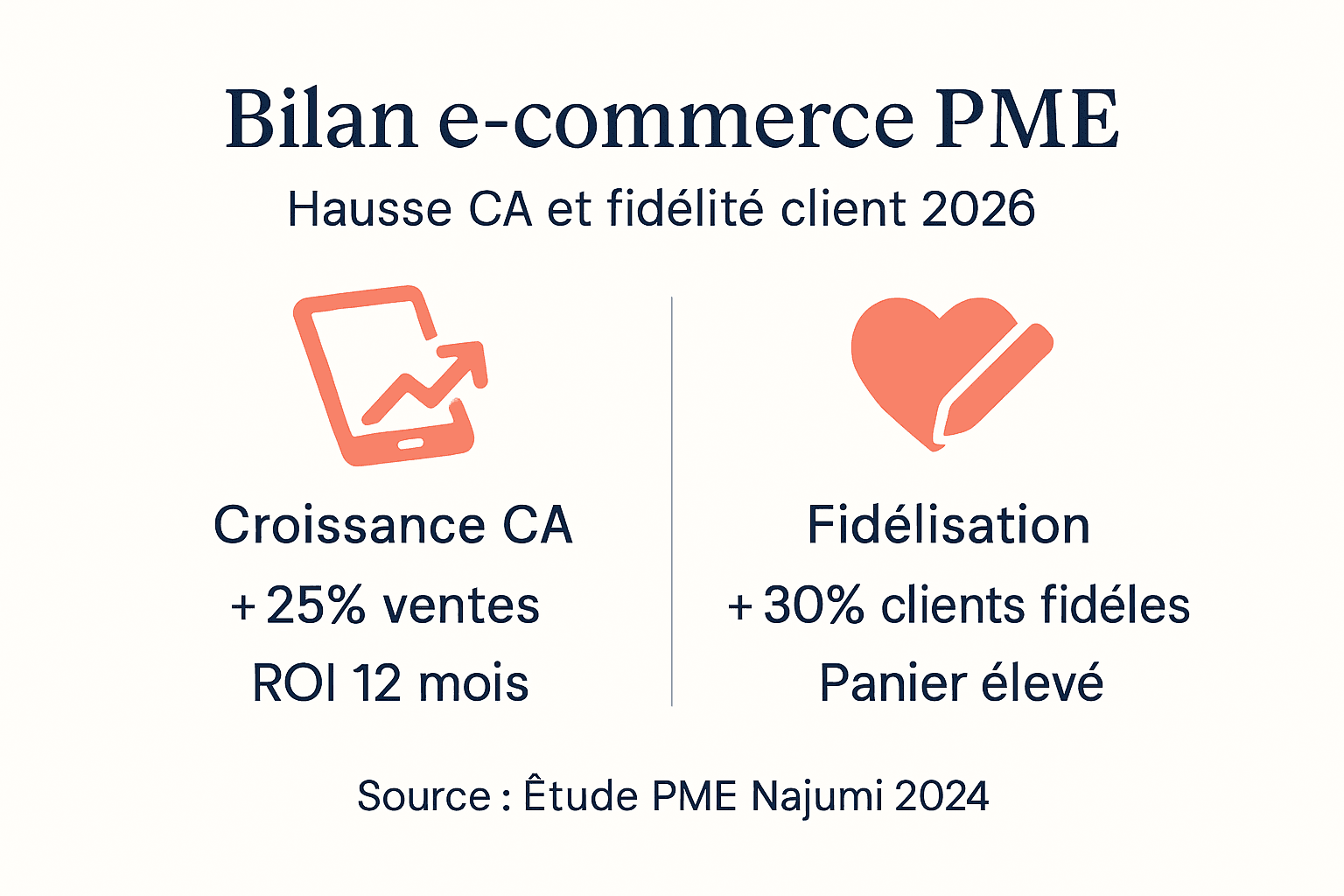
The following table compares performance before and after deploying a personalized solution:
| Indicator | Before Deployment | After 12 Months | Change |
|---|---|---|---|
| Monthly Revenue | €100,000 | €125,000 | +25% |
| Monthly Organic Traffic | 5,000 visitors | 7,500 visitors | +50% |
| Conversion Rate | 1.8% | 2.7% | +0.9 point |
| Average Basket | €85 | €98 | +15% |
Your online visibility benefits directly from a technically optimized architecture for natural referencing. Organic traffic grows up to 50% thanks to a tailored SEO content structure and optimal loading performance. This improvement translates into a higher ranking on strategic queries in your sector.
Pro tip: Integrate your SEO strategy from the site design phase. The technical architecture directly influences your ability to rank on priority keywords. Involve an SEO expert in the scoping workshops to avoid costly later restructurings.
The personalized user experience strengthens your brand notoriety. You create a coherent visual identity that anchors your positioning in visitors' minds. Modern web design boosts visibility and growth by facilitating memorization and spontaneous recommendation.
Your competitors relying on generic templates struggle to differentiate. Your custom interface becomes a major competitive advantage, especially in saturated sectors where visual innovation captures attention.
"A personalized online store transforms each visitor into a potential ambassador. A strong visual identity generates digital word-of-mouth, amplifying your organic reach."
This increased visibility monetizes directly. Each additional traffic point increases your conversion opportunities and lowers your long-term customer acquisition cost.
Improving Customer Experience and Loyalty
User interface personalization radically transforms customer relationships. You adapt purchase journeys, product recommendations, and communications according to behavioral segments. This targeted approach improves loyalty by 30% compared to standardized solutions.

Your customers benefit from a consistent experience across all touchpoints. The interface adapts to their purchase preferences, browsing history, and past behaviors. This continuity strengthens the feeling of personalized attention and stimulates repeat purchases.
Targeted offers rely on fine analysis of collected customer data. You identify optimal purchase moments, relevant complementary products, and promotions likely to trigger an order. This commercial intelligence transforms your marketing from opportunistic to predictive.
Pro tip: Focus on emotional design to firmly anchor the customer relationship. Microinteractions, subtle animations, and visual feedback create an emotional connection that goes beyond a simple commercial transaction. These details make the difference between a one-time purchase and long-term loyalty.
Customer data collection and analysis refine your marketing targeting. You segment audiences by precise behavioral criteria: purchase frequency, average basket, preferred categories, price sensitivity. This granularity enables ultra-personalized email campaigns with open rates 40% higher.
Your psychology and design-based strategy leverages cognitive biases to subtly guide buying decisions. Information architecture, visual hierarchy, and strategic calls-to-action maximize conversions and satisfaction simultaneously.
Loyal customers generate 67% more revenue than newly acquired ones. Your investment in personalized experience quickly pays off via churn reduction and higher lifetime value. This user-focused approach becomes your main lever for profitable growth.
Automation and Optimization of Internal Processes
Automating operational processes represents a major productivity gain. SMEs reduce order processing time by 40% by automating repetitive tasks. This efficiency frees your teams for higher value missions.
40% reduction in order processing time thanks to smart e-commerce process automation
Your e-commerce solution automatically synchronizes data between the online store and management systems. ERP/CRM integration eliminates double entries, a frequent source of costly errors. Stock levels update in real-time, avoiding overselling and stock-outs that degrade customer experience.
Automated processes cover the entire value chain:
- Automatic generation of invoices and accounting documents
- Instant update of stock levels across all channels
- Automated customer notifications on order and delivery status
- Intelligent abandoned cart follow-ups with optimized timing
- Customer data synchronization between CRM and e-commerce platform
- Dynamic calculation of shipping costs based on weight, destination, and promotions
Reducing human errors directly impacts your profitability. Each incorrectly entered order generates additional processing costs, customer disputes, and reputation damage. Automation ensures reliability and consistency across all transactions.
Your operational costs decrease proportionally with volume handled. The economies of scale become real: you handle 50% more orders without proportional hiring. This organizational agility supports your growth without compromising service quality.
Time savings translate into increased commercial responsiveness. You respond faster to customer requests, quickly adjust your offer according to detected trends, and test new segments without operational burdens. This agility becomes a decisive competitive advantage in dynamic markets.
Selection Criteria for a Custom E-commerce Solution
Investment in a tailor-made solution remains accessible from €5,000 with ROI visible in 12 months for French SMEs. This initial budget covers design, development, and basic integration. ROI materializes through increased revenue and reduced operational costs.
Your evaluation should compare standardized SaaS solutions and custom developments based on four decisive criteria:
| Criterion | SaaS Solution | Custom Solution |
|---|---|---|
| Initial Cost | €50 to 300/month | €5,000 to 30,000 one-time |
| ERP/CRM Integration | Limited, standard connectors | Full, custom APIs |
| Scalability | Constrained by vendor roadmap | Unlimited per business needs |
| Technical Support | Generic, variable response time | Dedicated, close support |
| Total 3-Year Cost | €1,800 to 10,800 + modules | €5,000 to 35,000 incl. maintenance |
Total cost of ownership over 3 years often favors custom for SMEs with specific needs. Najumi e-commerce solutions adapt precisely to your business reality, avoiding extra costs of unnecessary modules or costly technical workarounds.
Your selection process follows five structured steps:
- Map your current business processes and integration needs with existing systems
- Define your overall budget including development, team training, and annual maintenance
- Evaluate at least three providers based on client references in your sector and technical expertise
- Compare technical proposals by scalability, performance, and included support criteria
- Verify ERP/CRM integration capability with a concrete demonstration on your data
Pro tip: Favor local and dedicated technical support. Geographic proximity facilitates collaborative workshops, quick adjustments, and critical incident resolution. A Lyon-based provider like Najumi better understands the specifics of the French market and local regulatory constraints.
Scalability is often overlooked. Your solution must absorb growth in product catalog, traffic, and business features without a full overhaul. Demand a modular architecture allowing progressive additions without compromising performance.
Technical support determines your operational peace of mind. Verify guaranteed response times, hotline availability, and real expertise of the team on your technology stack. Responsive support minimizes incident impact on your commercial activity.
Common Challenges and Best Implementation Practices
Technical obstacles slow down 60% of SME e-commerce projects. Poor integration with existing systems generates data inconsistencies and user frustration. You must anticipate these challenges to guarantee deployment success.
25% of SMEs neglect tracking key performance indicators, drastically limiting commercial performance. Without KPI dashboards, you manage blindly. It's impossible to identify growth levers or customer journey friction points without structured data.
The most frequent implementation errors include:
- Underestimating training needs for teams on the new tool
- Absence of data migration plan from old systems
- Neglecting user testing before production launch
- Lack of planning for seasonal peak loads
- Forgetting SEO content strategy to feed organic traffic
- Lack of business team involvement during design phase
Best practices rest on three fundamental pillars. Regular training ensures smooth adoption by sales and customer service teams. Organize monthly practical sessions to maintain mastery levels and share usage tips.
Your KPI dashboard must display in real-time conversion rate, average basket, traffic sources, and SEO performance. These metrics guide strategic decisions and tactical adjustments. Consult the dashboard daily to quickly detect anomalies.
Strategic planning anticipates business evolution and volume growth. Schedule semi-annual upgrades incorporating user feedback and new market features. This product roadmap maintains your solution’s competitiveness over time.
Pro tip: Involve your teams from the start of the project to ensure smooth adoption. Employees engaged in design become internal ambassadors and facilitate change. Their business expertise enriches features and prevents unusable off-the-shelf developments.
Steps for successful e-commerce site include iterative validation with end users. Regular testing reveals journey friction before production launch. This agile approach reduces risks and accelerates time-to-market.
Reducing cart abandonment requires fine analysis of exit points. Identify problematic steps via heatmaps and session recordings. Optimize forms, clarify hidden fees, and simplify payment processes to recover 15 to 25% of lost conversions.
Conclusion and Strategic Implementation
Custom e-commerce solutions offer three major benefits to French SMEs: 25% revenue growth, 30% improved loyalty, and 40% reduced processing time. These measurable gains justify the accessible initial investment starting at €5,000.
Your success depends on choosing a solution perfectly adapted to your business specifics. Generic platforms constrain your differentiation and limit scalability. A personalized approach maximizes impact on your priority business goals.
Najumi has supported Lyon-based and French SMEs in designing and deploying custom e-commerce solutions since 2020. Our expertise covers needs analysis, technical development, complex integrations, and continuous optimizations post-launch.
Your next concrete steps:
- Audit your current processes and identify priority improvement points
- Define a realistic overall budget and deployment timeline
- Contact Najumi experts for a free personalized diagnosis
- Plan a pilot phase on a limited customer segment before generalization
Each month of delay represents lost commercial opportunities versus digital competitors. Act now to capture sectoral e-commerce growth and secure your sustainable market position.
Boost Your SME with Najumi: Custom E-commerce Solutions
Looking to transform your business through online commerce? Najumi designs personalized e-commerce solutions tailored to the realities of French SMEs.
Our support covers the entire project cycle: from initial scoping workshop to post-launch performance monitoring. We integrate your existing systems, train your teams, and continuously optimize your platform based on real data.
Discover our Web & Tech Toolbox featuring practical resources, methodological guides, and ROI calculators to efficiently manage your digitalization. Also consult the 6 essential steps to create an effective e-commerce website to structure your project.
Contact Najumi today for a free personalized diagnosis and launch your winning e-commerce project.
Frequently Asked Questions
What are the main benefits of a custom e-commerce solution for an SME?
A personalized solution increases revenue by 25% on average, improves loyalty by 30%, and reduces order processing time by 40%. It precisely adapts to your business processes, unlike standardized platforms imposing their constraints.
What budget should I plan for a custom e-commerce solution?
Projects start from €5,000 for a basic store with essential integrations. ROI becomes visible within the first year thanks to revenue growth and reduced operational costs. Compare total 3-year costs with SaaS solutions to identify the most profitable option according to your activity volume.
How can I ensure successful integration with my existing ERP and CRM systems?
Choose a provider experienced in complex integrations who audits your current systems before making a technical proposal. Demand custom APIs ensuring real-time data synchronization. Schedule a thorough testing phase with real data before production switch to avoid costly inconsistencies.
What is the difference between a custom e-commerce solution and a standard SaaS platform?
Custom offers unlimited scalability, deep integrations with your business tools, and dedicated close support. SaaS suits standardized needs with predictable monthly budgets but limits customization and depends on vendor roadmap. Choose based on the complexity of your processes and growth ambitions.
How do I track the performance of my online store after launch?
Implement a KPI dashboard showing conversion rate, average basket, traffic sources, and SEO performance in real-time. Check these metrics daily to quickly detect anomalies. Arrange monthly reviews with your provider to analyze trends and prioritize high-impact business optimizations.